

🌱 Soil NO₃ + NDVI / Dry Matter Cross Mapping
Next Generation Nutrient Diagnosis
🔬 Overview
The combination of soil nitrate (NO₃) maps with NDVI and Dry Matter (DM) imagery enables a new generation of agronomic diagnostics by integrating nutrient availability at the soil level with crop biomass expression in real time.
Merging maps allow to reconfigure and combine nutrient doses at soil level (NO3) and in leaves during any stage of the crop cycle. These developments are typically checked using indexes such as NDVI, which is available as a digital option in our diagnostic service.
This cross-mapping approach allows nutrient strategies to be dynamically adjusted throughout the crop cycle, optimizing both soil fertility management and canopy performance.
NDVI is available as part of our diagnostic services in:
High-resolution formats (3 × 3 m pixels)
Natural color vegetation imagery
🌾 Recommended Applications
Our technical recommendation is to apply this methodology to:
Fruit trees → High-resolution NDVI
Perennial pastures (pure alfalfa or mixed grasses) → NDVI or Dry Matter
Semi-annual crops → Dry Matter-based diagnostics
Soil NO3 with Dry Matter of corn crop
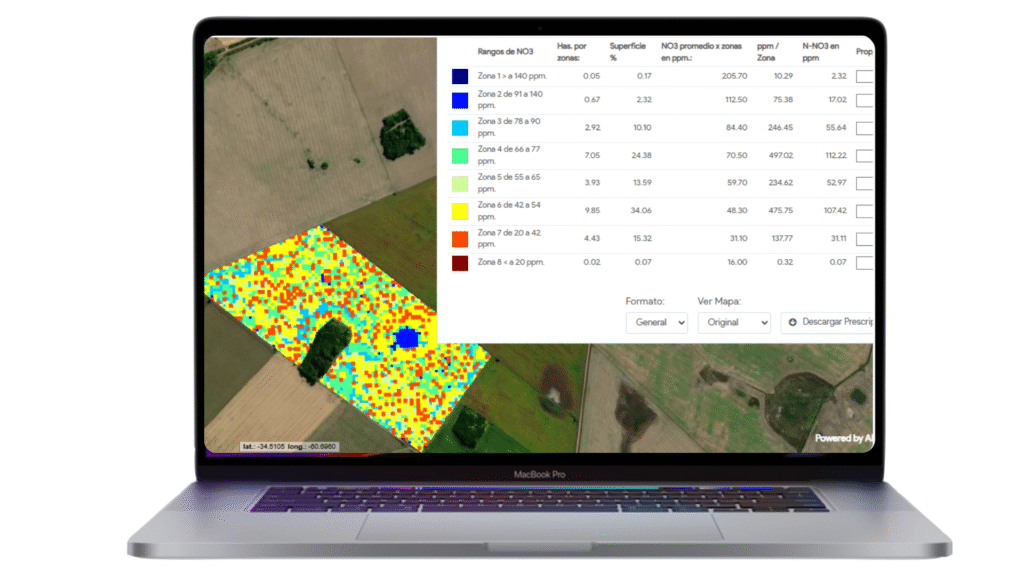
Soil NO3 with standard NDVI
✅ Key Advantages
Variable-rate optimization:
Reduce fertilizer doses in zones where biomass development is limited, regardless of soil NO₃ levels — and increase inputs where biomass potential and nutrient availability are aligned.Targeted yield maximization:
Increase nutrient supply in high-NO₃ zones to drive localized biomass peaks in variable-density crop populations.Integrated nitrogen strategy:
Enables foliar nitrogen supplementation based on combined analysis of soil NO₃ and total nitrogen dynamics.
🔄 Ongoing Developments
This cross-mapping methodology is currently being standardized for:
Phosphorus (PO₄)
Calcium (Ca)
Sulfur (S)
Potassium (K)
Across both soil available fractions and leaf tissue concentrations.